Historical Context
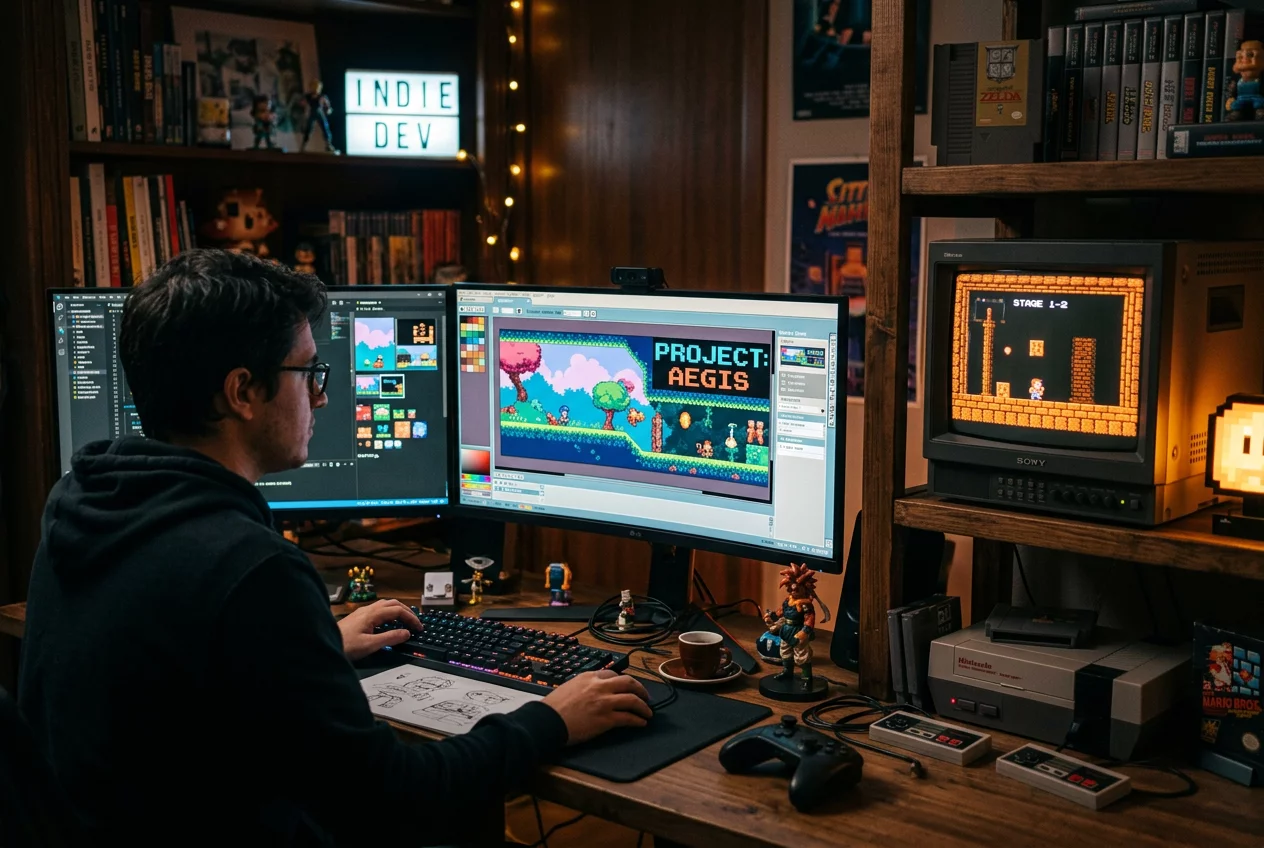
In the landscape of modern digital entertainment, indie developers often look back to the 1985 standard to understand the core of engagement. The crown of game design wasn't won with high-fidelity graphics, but through a perfect marriage of physics and level layout. Today, when creators launch their projects online, the DNA of Super Mario Bros. is visible in every pixel-perfect jump and hidden secret. It established a grammar of movement that is still taught in game design schools as the ultimate curriculum.
Key Technical Insight
The 'Coyote Time' and jump buffering found in modern hits like Celeste directly evolve from the forgiving yet precise momentum physics first explored in 1985.
Legacy Impact
The minimalist approach of 1985 forces developers to narrate through gameplay rather than cutscenes. This 'show, don't tell' philosophy remains the guiding star for indie studios working with limited budgets but unlimited imagination. By stripping away the noise, they find the same rhythmic loop that made the original NES title an eternal classic. It is the foundation upon which the indie crown rests, proving that great mechanics are timeless.
The Democratization of Design
Indie developers in the 2010s did not merely reference Super Mario Bros.; they used it as a foundational text. Games like Celeste, Shovel Knight, and Super Meat Boy all begin from the premise that Mario established: platforming is not about precision alone, but about the emotional relationship between player and character. These indie titles strip away the graphical excess of AAA production and return to the core vocabulary that Miyamoto defined in 1985: jump, run, stomp, explore. The resurgence of pixel art and chiptune music is not nostalgia; it is an acknowledgment that certain design truths are timeless.
The indie movement also inherited Mario's respect for player time. Just as World 1-1 teaches in sixty seconds, modern indie platformers aim to introduce mechanics within the first level. The design documents of successful indie studios often contain direct references to Mario's tutorial structure, with level designers explicitly mapping their introductory sections against the geometry of 1-1. The blueprints have been photocopied so many times that they are now part of the industry's genetic code.
Curator Note
Indie games prove that Mario's influence is not proportional to budget. A team of three developers with limited resources can create platforming joy by applying the same principles that governed a 1985 console blockbuster. The blueprint is free; the execution is what matters.

MUSEUM LOG
No comments yet. Be the first to leave a comment on this historical record.
To leave a comment, please log in to your account.