Historical Context
Before Super Mario Bros. dominated the home console market, video games were primarily designed for arcade cabinets. These machines had a simple goal: extract quarters by making players restart from the very beginning upon losing their last life. The idea of 'saving' your progress was virtually non-existent for the average player. When the Famicom and NES brought arcade-style action into the living room, developers faced a new challenge. Longitudinal play required a method to keep players engaged over hours rather than minutes. Super Mario Bros. utilized an ingenious system of Warp Zones and hidden shortcuts that functioned as a proto-save system, allowing seasoned navigators to 'skip' back to their previous progress points without hardware memory.
Key Technical Insight
The transition from high scores to level-based progression necessitated the shift towards battery-backed RAM and complex password systems, a bridge Super Mario Bros. helped build by popularizing long-form world structures.
Legacy Impact
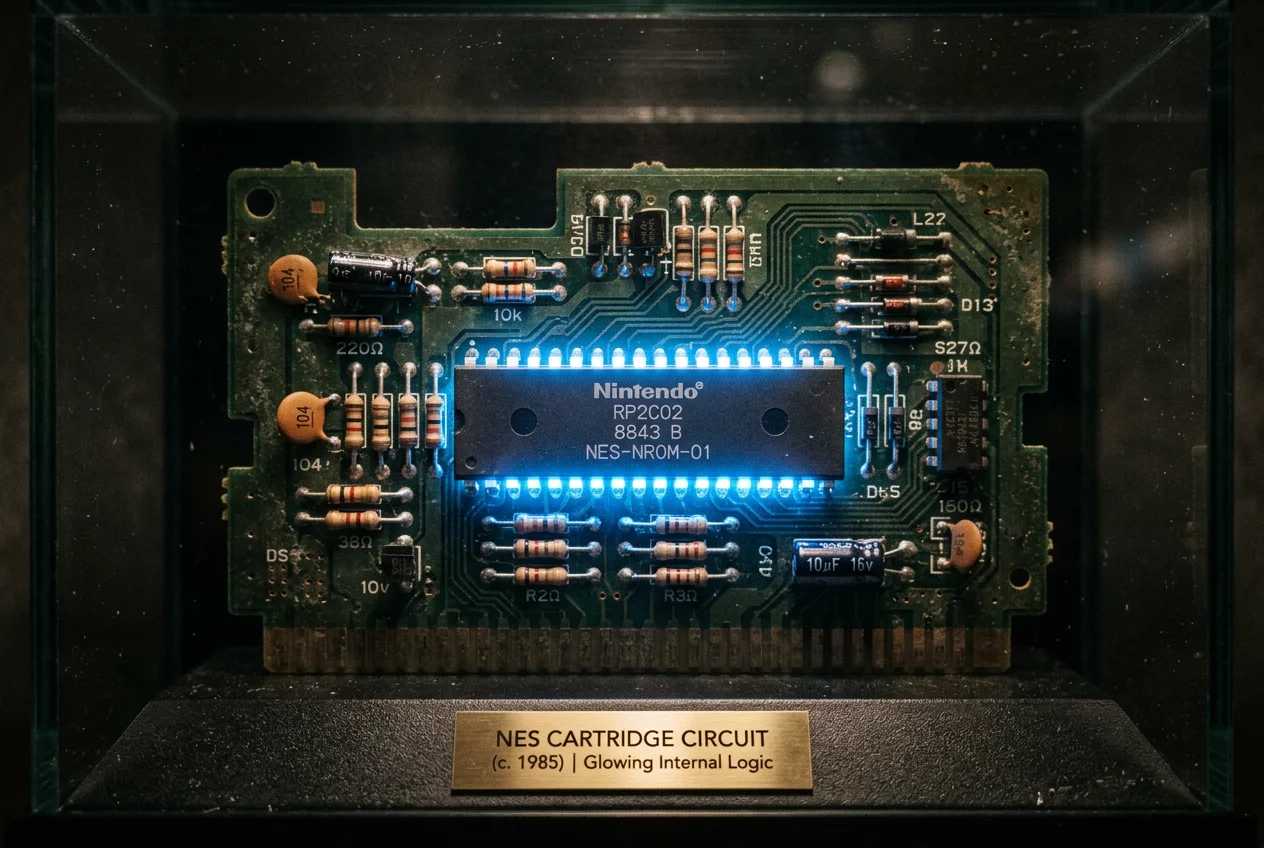
The success of Mario's multi-world structure paved the way for more complex save solutions. Shortly after, titles like The Legend of Zelda introduced Internal Battery Backup, but it was the Mario series that defined why we needed it. The concept of returning to a specific 'world' or 'stage' fundamentally changed the relationship between the player and the machine. It moved gaming away from being a disposable experience towards becoming a journey with a permanent crown of achievement for those who finished. Today, every cloud-sync and auto-save checkpoint online can trace its lineage back to these early struggles to preserve progress against the limitations of 8-bit read-only memory cartridges.
Progress Before Persistence
Super Mario Bros. had no save system. Progress was measured not in stored data but in personal skill. When a player reached World 8-1, they did so through accumulated mastery, not a loaded checkpoint. This design choice, born from hardware limitations, created a unique emotional stakes structure. Every playthrough was a complete journey, and every death sent the player back to the beginning to try again. The absence of saves made completion a genuine achievement in a way that modern checkpoint systems rarely replicate.
Yet the game did include a primitive persistence mechanism: the continue system. Players who reached certain milestones could restart from those points, creating a compromise between arcade-style single-sitting completion and the longer campaigns that home consoles enabled. This half-step toward save systems influenced the password systems of the late 1980s, the battery-backed RAM of the early 1990s, and eventually the unlimited saves of the modern era. Mario did not invent the save, but it defined the problem that saves would eventually solve.
Curator Note
The modern "roguelike" genre, with its emphasis on starting fresh and learning through failure, is essentially a return to Mario's original no-save philosophy. What was once a limitation has become a deliberate aesthetic choice.
MUSEUM LOG
This could be your first comment. Share your thoughts on the evolution of saves!
To leave a comment, please log in to your account.