Historical Context
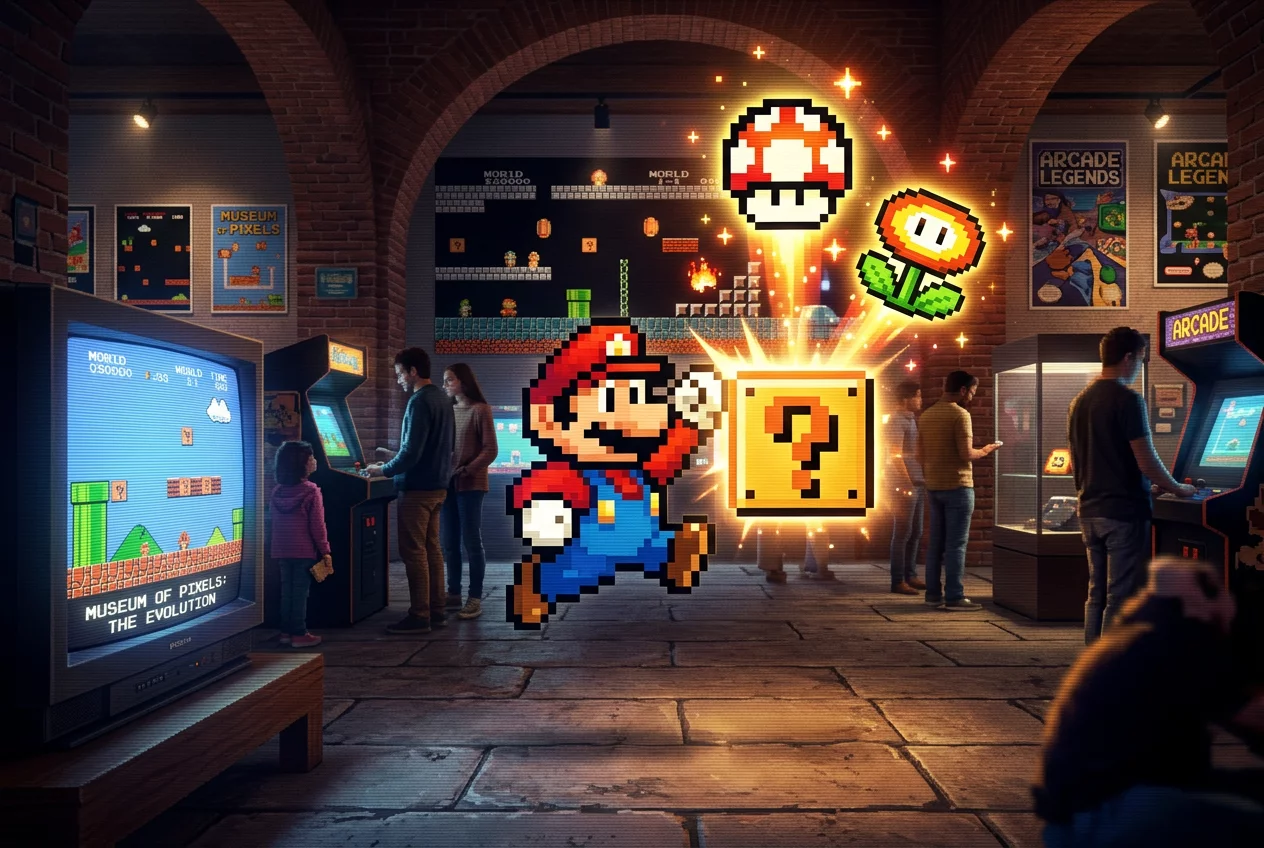
Before 1985, character progression in video games was often limited to score accumulation or simple weapon swaps. The introduction of the Super Mushroom in Super Mario Bros. changed everything. It didn't just give Mario a health point; it physically changed his presence on the screen. The transformation from Small Mario to Super Mario allowed for new interactive possibilities: breaking bricks, higher jumps, and a psychological shift in how players approached hazards. This risk-reward mechanic was born from technical limitations and a desire for intuitive tutorialization, forcing players to chase a moving target that initially resembles an enemy.
Key Technical Insight
Shigeru Miyamoto and his team designed the mushroom to pop out and move away from the player, forcing them to learn that not everything moving is a threat. This established the crown of intuitive game design in an era before tutorials existed online.
Legacy Impact
The power-up system became the structural heart of the platformer genre. It introduced the concept of temporary invincibility through the Starman, requiring players to speed through levels with a sense of urgent rhythm. The Fire Flower expanded the gameplay into a semi-combat experience, essentially giving the player a ranged toolset without removing the core platforming challenge. This multi-tiered system ensures that the game depth grows as the player finds hidden blocks, turning every level into a search for potential evolution.
Risk and Reward Architecture
The Super Mushroom and Fire Flower do more than grant abilities; they restructure the player's relationship with danger. At Small Mario, the player approaches each obstacle cautiously, aware that a single mistake ends the run. At Super Mario, confidence increases, but so does the stakes — losing the power-up represents a tangible regression. At Fire Mario, the player feels invincible, yet the knowledge that this state is temporary creates urgency. This three-tier emotional arc, repeated across every level, transforms a simple size-changing mechanic into a sophisticated difficulty modulation system.
The Starman introduces a fourth emotional state: temporary transcendence. For a brief window, the player becomes the hunter rather than the hunted, barreling through enemies that previously demanded caution. This cathartic release serves a psychological function beyond mere scoring. It breaks tension, rewards skilled play, and creates memorable peak experiences that players recount decades later. The power-up system of Super Mario Bros. is, at its core, an emotional regulation device disguised as item collection.
Curator Note
Modern games often confuse power-ups with mere stat increases. The original Mario power-ups were emotional states — fear, confidence, mastery, euphoria — mapped to visual transformations. This is why they remain iconic while countless +5 damage modifiers have been forgotten.
MUSEUM LOG
PixelHistorian
15/05/2026I never realized how much the mushroom movement actually teaches you. It's brilliant how it forces you to either interact or miss out.
MarioStarlight
18/05/2026The Starman music is still the most anxiety-inducing yet empowering sound in gaming history. Great exhibit!
RetroRaph
19/05/2026This archive perfectly captures why the online community still values the crown of early platformers. Truly a masterpiece analysis.
NostalgiaGeek
19/05/2026The sound of obtaining a power-up is burned into my soul. It feels like a small victory every single time.
ArcadeLover
19/05/2026Essential reading for anyone interested in game design. The power-up system is arguably the most important invention in platformers.
To leave a comment, please log in to your account.