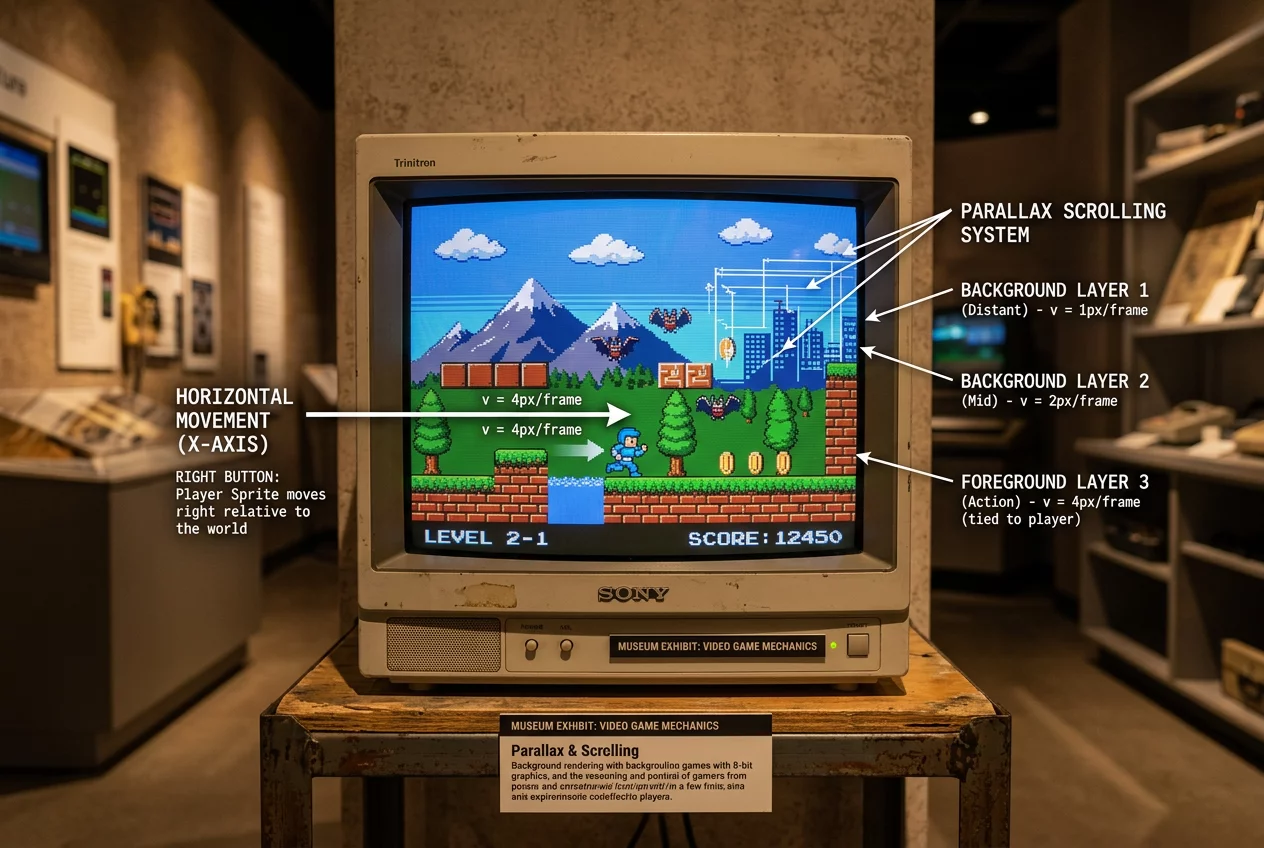
Historical Context
Historically, early console games were confined to single-screen environments or 'flip-screen' transitions where the action paused as the player reached the edge. In 1985, the introduction of smooth, multi-directional horizontal scrolling changed everything. This wasn't just a technical feat; it allowed for expansive level design that felt like a continuous journey. By locking the camera to the protagonist's position with specific 'dead zones,' developers created a sense of momentum previously unseen in home entertainment.
Key Technical Insight
The hardware utilized a nametable mirroring technique to pre-render parts of the level just off-screen, allowing the console to scroll the background smoothly without graphical tearing or flickering.
Legacy Impact
The legacy of this mechanic stretches into every modern 2D and 3D title. It established the 'rightward progression' as the universal language of adventure. Without this revolution, the intricate pacing of modern platformers would be impossible. It taught players that there was always something new just beyond the horizon, encouraging exploration and rewarding curiosity in a way static screens never could.
The Illusion of Infinity
Before Super Mario Bros., console platformers used flip-screen transitions that broke spatial continuity. The player advanced one screen at a time, with each transition acting as a hard reset of attention. The smooth scrolling of Mario changed everything. By maintaining a continuous camera that followed the player rightward, the game created a sense of forward momentum that felt cinematic. The world no longer consisted of discrete rooms; it was a single, coherent journey from left to right.
Technically, this required the Famicom to update background tiles in real time as the player approached the screen edge. The development team used a technique called nametable mirroring, where two identical background maps were stored in video memory and swapped seamlessly as the camera moved. This clever hack, born from hardware limitation, created an illusion so convincing that players genuinely felt they were exploring an endless kingdom rather than a carefully measured sequence of tiles.
Curator Note
The rightward scroll established a cultural convention so powerful that even three-dimensional games often default to left-to-right progression in tutorial sections. Mario didn't just invent scrolling; it invented the direction of adventure itself.
MUSEUM LOG
This could be your first comment. Share your thoughts on this exhibit below!
To leave a comment, please log in to your account.