Historical Context
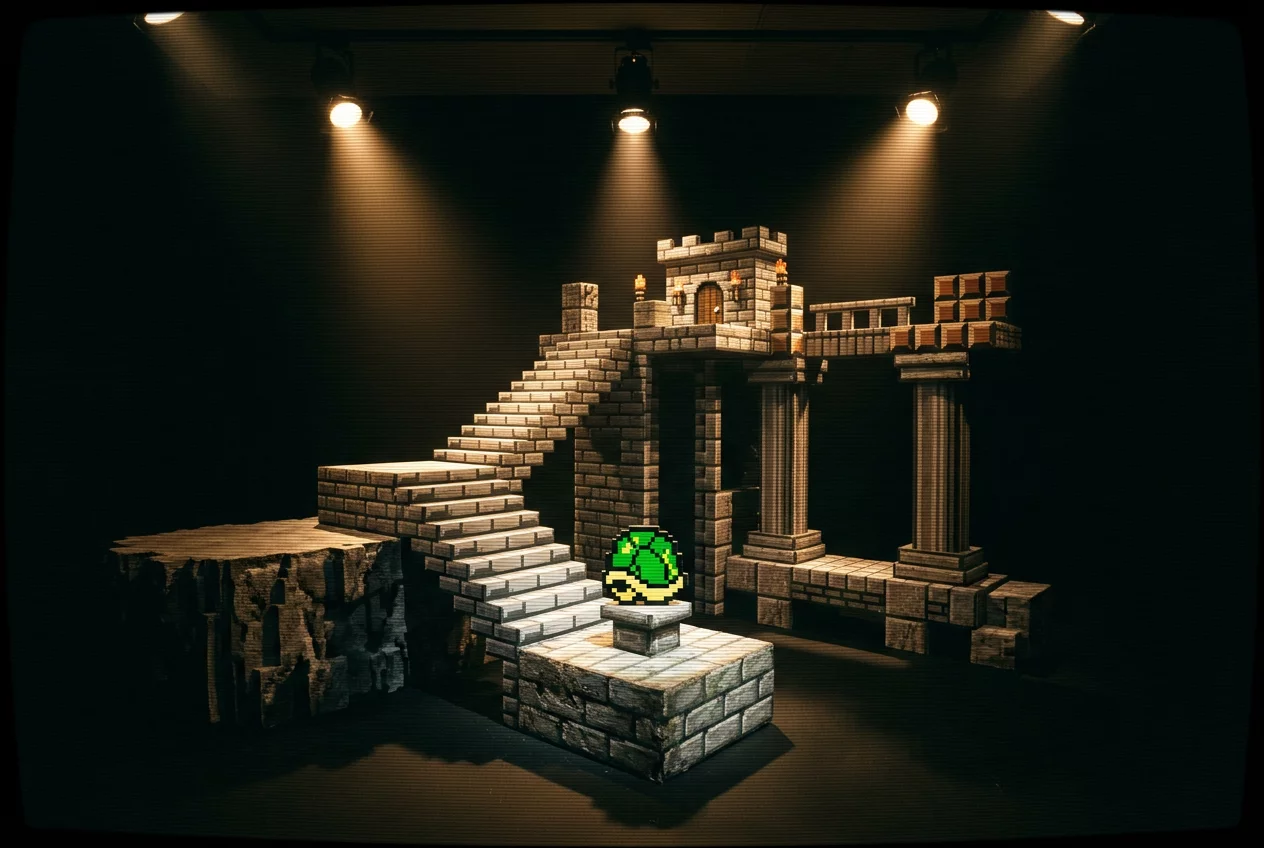
The "infinite lives" glitch, often referred to as the 1UP shell trick, represents a pivotal moment in gaming history where players discovered that the game's internal scoring system could be bypassed. Located primarily in World 3-1, the trick involves trapping a Koopa Troopa shell against a staircase. When the character jumps on the shell repeatedly without hitting the ground, the internal point counter eventually overflows. This wasn't necessarily a bug in the traditional sense, but rather an emergent property of the game's physics and scoring logic. Shigeru Miyamoto later confirmed that the development team knew about the possibility but decided to leave it in as a reward for skilled players who could master the precise timing.
Key Technical Insight
The trick works because the game increments the point value for consecutive bounces on enemies. Once the value exceeds the maximum defined score per hit (8,000 points), the internal logic switches to awarding 1UPs instead of numeric points. This overflow mechanic became a legendary exploit.
Legacy Impact
This exploit changed how developers viewed player agency. It turned a simple platformer into a space for experimentation. The "shell bounce" became a rite of passage for console owners and a staple of gaming magazines for years. It also influenced the design of future titles, where developers purposefully hid similar 1UP opportunities. The trick even gained its own name in Japan: "The Infinite 1UP." Today, it remains one of the most documented secrets in the 8-bit era, symbolizing the hidden depth found within a seemingly straightforward cartridge.
The Culture of the Secret
The infinite 1-Up trick on World 3-1 did not spread through official channels. It propagated through playground whispers, handwritten notes passed between classmates, and the emerging BBS networks of the late 1980s. This organic distribution network created a culture of secret-sharing that predated the internet's information economy. Players who discovered the trick gained social capital; those who learned it secondhand felt included in an exclusive club. The trick was not merely a gameplay exploit; it was a social currency.
The technique itself requires precision. By kicking a Koopa Troopa shell into a staircase of Goombas at the correct angle, the player can rack up points that eventually convert to extra lives at an accelerating rate. The timing is tight, the setup specific, and the reward disproportionate. This combination of difficulty and payoff makes the trick feel earned rather than cheated — a crucial distinction that separates beloved secrets from despised exploits. Players do not feel guilty about infinite lives; they feel proud of having mastered the system.
Curator Note
The infinite lives trick is perhaps the earliest example of a "viral" gaming secret. Its spread through pre-digital social networks demonstrates that games have always been cultural artifacts, not merely commercial products.
MUSEUM LOG
No archive logs yet. This could be your first entry.
To leave a comment, please log in to your account.