Engineering Within Limits
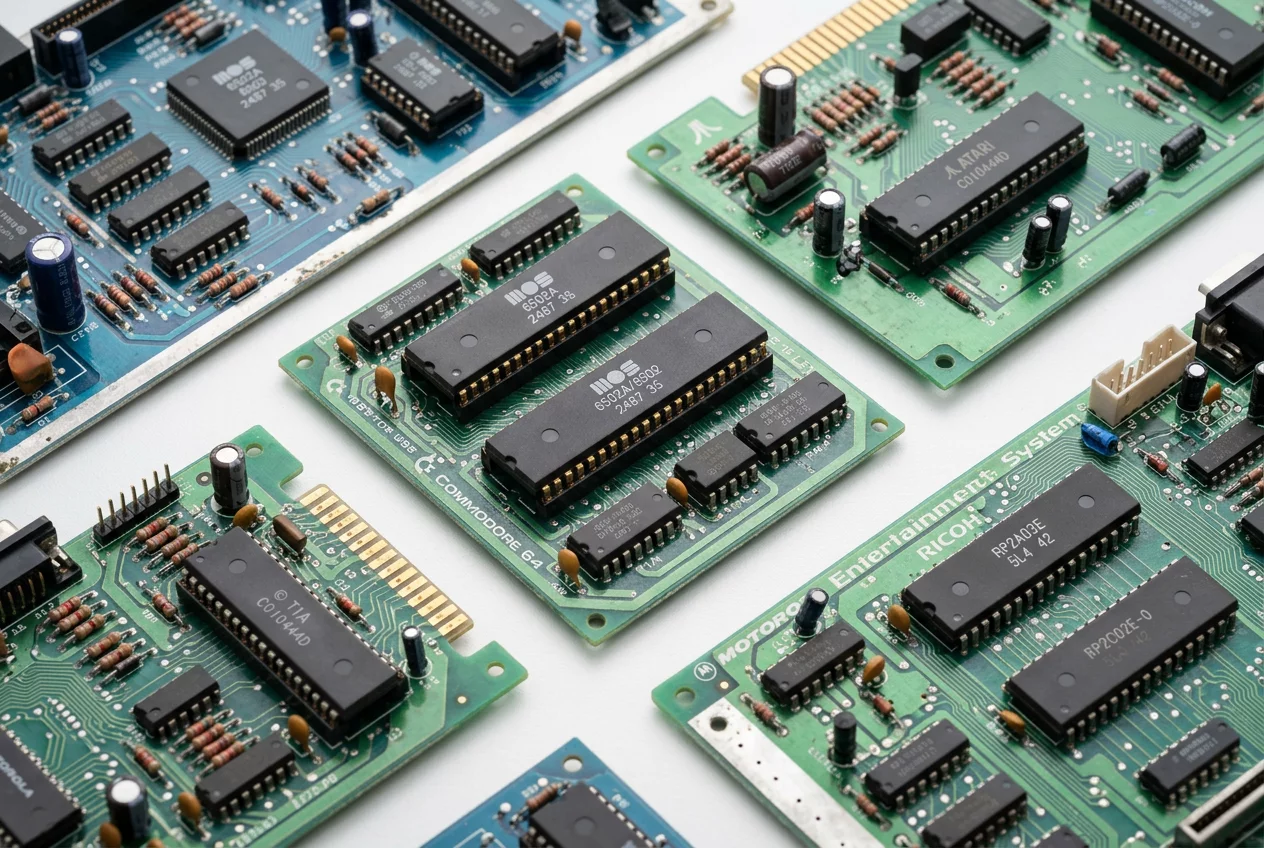
The Family Computer, released in 1983, was not designed to host sprawling platforming adventures. Its Ricoh 2A03 processor operated at a modest 1.79 MHz, and the Picture Processing Unit could display only 64 sprites across the entire screen. Yet within these rigid confines, Nintendo's engineers forged a scrolling engine so fluid that it felt like a revelation to players accustomed to static-screen arcade ports. This exhibit examines the hardware constraints that paradoxically inspired some of the most enduring design choices in interactive entertainment history.
The Scrolling Miracle
To achieve smooth horizontal scrolling, the development team implemented a technique that updated background tiles just outside the visible viewport, creating the illusion of an infinite world on hardware never intended for such traversal.
Memory Cartography
With merely 2 KB of video RAM available for background patterns, every tile had to earn its place. The iconic brick block, question block, and ground textures were reused with surgical precision across all 32 levels. This repetition was not laziness; it was architectural necessity. By establishing a visual vocabulary of reusable elements, the designers created a coherent universe that players could read intuitively. The limited palette of 48 colors and 8 sprites per scanline further dictated the silhouette-driven character design that made Mario instantly recognizable even at 16 pixels tall.
Audio as Architecture
The Ricoh 2A03 contained a built-in audio processing unit with five channels: two pulse wave, one triangle wave, one noise, and one delta-modulation channel for sample playback. Koji Kondo composed the entire score using only these five voices, yet created what would become the most recognizable melody in gaming. The hardware mandated that music could not simply accompany the action; it had to serve as an emotional compass, directing player attention and reinforcing rhythmic movement through levels. This symbiotic relationship between silicon limitation and creative expression remains a masterclass in resourceful design.
Looking back from an era of teraflops and ray tracing, the Famicom hardware analysis reveals a truth often forgotten: limitations breed innovation. The console was not a canvas; it was a puzzle, and solving it required equal parts engineering rigor and creative audacity. Every frame of Super Mario Bros. is a testament to what happens when brilliant minds refuse to accept the boundaries of their medium.
Legacy in Silicon
The Famicom's influence extends far beyond its commercial lifespan. The 6502-based processor architecture became a teaching tool for computer science education, with universities using its simple instruction set to introduce students to assembly language programming. The Picture Processing Unit's tile-based rendering system directly influenced the graphics pipelines of early mobile phones and handheld consoles. Even the audio chip's five-channel limitation inspired a generation of chiptune musicians who continue to compose new works using original hardware or faithful emulations. The Famicom was not merely a console; it was a creative ecosystem.
Preservation efforts have further cemented the hardware's cultural significance. Museums and private collectors now treat Famicom development kits as historical artifacts, with some units selling for thousands of dollars at auction. The original circuit boards, with their hand-soldered components and bespoke memory mappers, represent a transitional moment in manufacturing — the bridge between bespoke arcade hardware and mass-produced consumer electronics. Every capacitor and resistor tells a story of an industry learning to scale.
Curator Note
Understanding the Famicom's limitations is essential for understanding why Super Mario Bros. looks and plays the way it does. The game is not an abstract design; it is a physical object sculpted by the properties of silicon and copper.

MUSEUM LOG
To leave a comment, please log in to your account.