The Invisible Tutorial
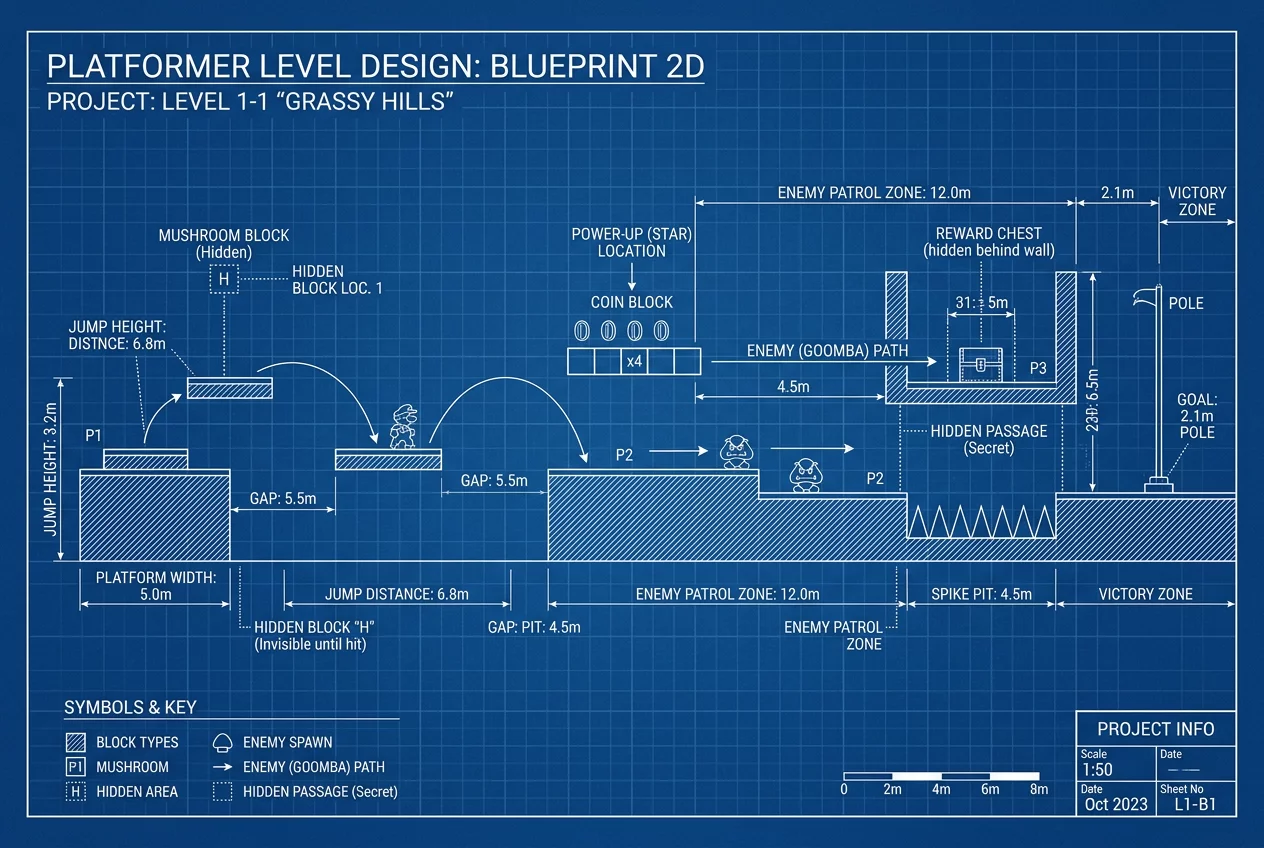
Shigeru Miyamoto and his team faced a monumental challenge in 1985: they needed to teach a global audience how to play a game with complex horizontal momentum without using a single word of text. World 1-1 functions as a silent instructor, guiding the user through a series of carefully constructed hazards that reward curiosity and safe experimentation. It isn't just a level; it's a structural masterpiece that established the crown of platforming mechanics for every online and offline title that followed.
The Mushroom Philosophy
The first Super Mushroom is placed specifically to bounce off a pipe and move toward the player, making it nearly impossible to avoid. This force-fed reward teaches that not everything that moves is an enemy, instantly establishing the core power-up loop.
Architectural Geometry
The layout uses the screen's negative space to draw the player's eye toward the right. Notice how the first Goomba is spaced exactly to allow enough time for reaction, yet close enough to feel threatening. This balance between safety and danger creates the rhythmic flow that defines the entire experience. By the time the player reaches the first pipe, they have already learned to jump, run, and identify threats—all within the first fifteen seconds of play.
Curriculum Design
World 1-1 is essentially a curriculum compressed into sixty seconds. The opening flat ground teaches running. The first question block teaches upward interaction. The Goomba teaches threat avoidance. The pipe teaches vertical traversal. The pit teaches jump precision. Each element appears exactly once before combining with others, creating a scaffolded learning experience that requires no manual, no tutorial text, and no hand-holding. This pedagogical approach has been emulated by virtually every successful platformer since, from Sonic the Hedgehog to Celeste.
The genius of teaching without words lies in respecting the player's intelligence. Rather than explaining mechanics through text boxes, World 1-1 creates situations where discovery feels like personal achievement. When a player accidentally breaks a brick from below and realizes they can now access hidden areas, the emotion is not confusion followed by comprehension, but surprise followed by delight. This emotional arc — from curiosity to mastery — became the blueprint for tutorial design across the entire industry, proving that the best teacher is not a manual, but a well-designed world.
The Global Classroom
World 1-1's tutorial design succeeded because it required no literacy, no language proficiency, and no cultural context. A child in Tokyo and a child in New York learned the same lessons from the same geometry. This universality was not accidental; it was the result of a deliberate decision to communicate through action rather than text. In an era when game manuals were often thicker than the cartridges themselves, Mario taught players everything they needed to know simply by placing objects in specific relationships to one another.
The educational establishment has taken notice. Universities now use World 1-1 as a case study in instructional design, comparing its scaffolded complexity to the spiral curricula of modern pedagogy. The level's ability to teach without explicit instruction mirrors the constructivist philosophy of education, where learners build understanding through interaction with their environment rather than passive reception of information. A video game level designed in 1984 anticipated the educational theories that would dominate classrooms in the 2020s.
Curator Note
When educators discuss "gamification" of learning, they are often unconsciously describing the principles that Miyamoto encoded into sixty seconds of platforming. The best educational technology may not be an app or a platform; it may be a carefully placed question block.

MUSEUM LOG
To leave a comment, please log in to your account.